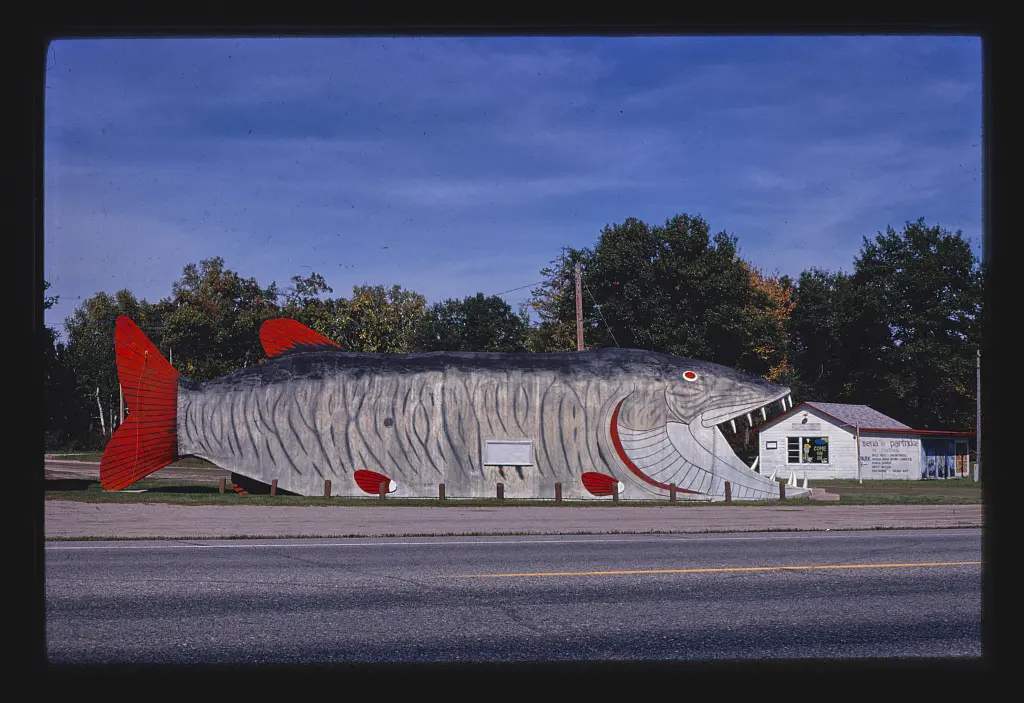
A fish large enough to contain its customers reverses the familiar relationship between diner and dinner. That reversal is the architectural joke at Bena's Big Fish. The Library of Congress identifies John Margolies's 1980 photograph with the Big Fish Supper Club in this Minnesota community.[1]
The Center for Land Use Interpretation describes the structure as a 65-foot muskie, originally a drive-in with a small eating area inside. Its account places construction in the late 1950s and locates the attraction near Lake Winnibigoshish.[2] Fish imagery thus gives the business an association with its lake-country setting. A giant specimen can promise an experience of the region as well as a meal; the architecture makes that promise at the scale of the highway.
A particularly useful history comes from an interview with Arnold “Butch” Dahl, who helped build the fish as a teenager. He recalled Wayne Kumpula's painting, a mouth entrance, a small interior counter, and a walk-up window. Circular Coca-Cola signs became eyes and cedar posts became teeth. The interviewer acknowledges disagreement over whether construction occurred in 1957 or 1958; the evidence supports the decade more securely than one exact year.[3]
These recollections shift attention from the improbable silhouette to the practical work of making it. A soft drink sign became an anatomical feature. Ordinary posts became teeth. The change in meaning depends on placement and scale, not on expensive material. Read this way, the muskie is an assembly of familiar things made strange by a builder's imagination.
The same reported history describes a later souvenir-shop use and a 2009 repair campaign, including repainting by artist Josh Porter. Porter explained that he was asked to respect the original's local, handmade character.[3] That is a revealing preservation problem. Making a roadside sculpture more polished can erase the qualities that made people recognize it.