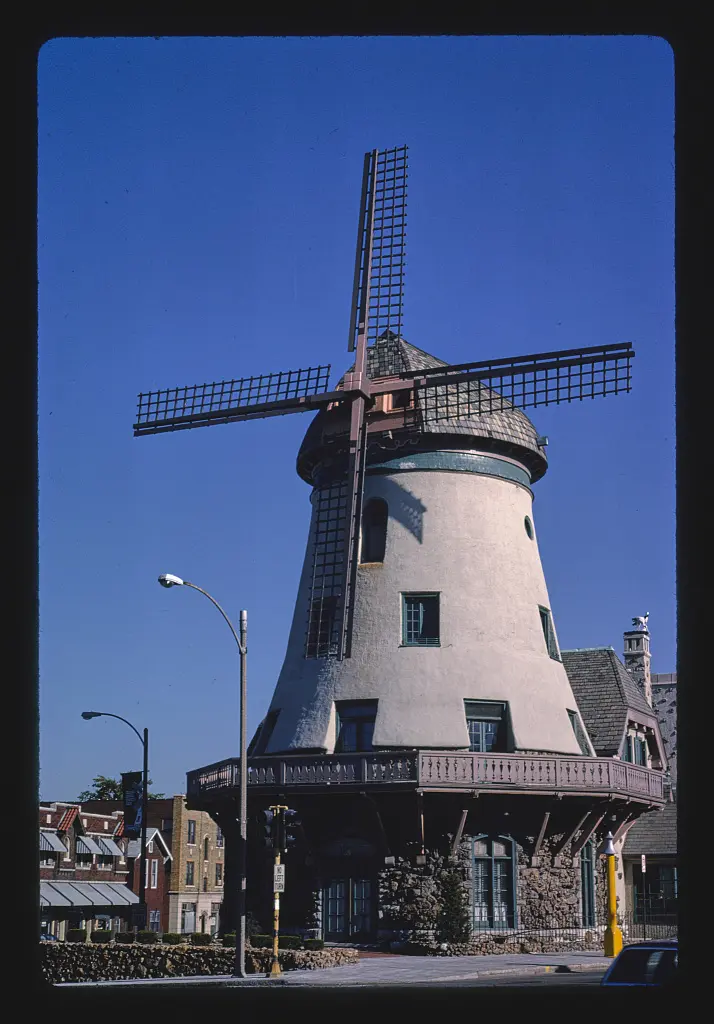
A windmill suggests work: turning blades, moving machinery, the transformation of grain. At Bevo Mill, that association became part of the public identity of a restaurant. John Margolies photographed the St. Louis landmark in 1988.[1] The object belongs to a city street as much as to the imagined European landscape its form evokes.
The city's cultural-resources account says August Busch Sr. conceived the project after a trip to Holland, seeking a European-style beer garden in St. Louis. Architects Klipstein and Rothman designed it in Tudor Revival style. Its name came from Bevo, an Anheuser-Busch malt beverage, and the city designated the building a landmark in 1971.[2] The mixture of references is itself instructive: a Dutch-inspired idea and a Tudor architectural description need not form a historically pure composition to work as commercial imagery.
A municipal preservation history dates the building to 1917 and places it in the context of the temperance movement. It describes a family restaurant promoting the company's nonalcoholic Bevo beverage, with a four-story mill connected to a half-timbered building.[3] The architecture was therefore associated with an attempt to adapt a brewing company's public offer to a changing political and social environment.
The mill can be read as a bridge between product and place. Grain has an obvious relationship to malt, but the building does not need to explain production in detail. It supplies an atmosphere of craft, tradition, and European sociability. Such associations are commercially useful precisely because they arrive as impressions. A visitor may recognize a promise of hospitality without identifying an architectural source.
The restaurant's form also complicates a simple division between practical buildings and advertisements. Its exterior advertises an experience, while its interior provides the setting in which that experience can occur. The sign and the place reinforce each other. An ordinary nameboard could announce a restaurant, but it could not so readily make the meal seem part of a distinctive outing.