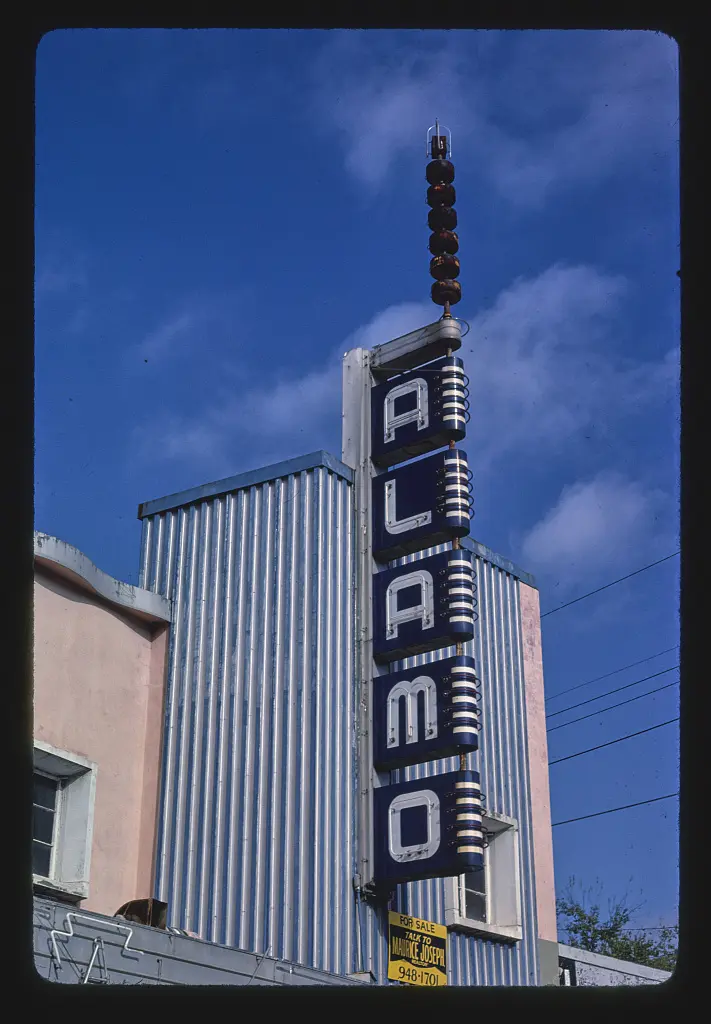
A theatre detail can be an invitation to recover the people missing from the frame. John Margolies photographed the Alamo in Jackson in 1986, according to the Library of Congress catalog.[1] The image identifies a building, but the institution's history reaches beyond that one structure. Its significance depends on performances, audiences, and opportunities that a facade alone cannot explain.
Mississippi's historic-property inventory identifies the North Farish Street building as the Alamo's third location. Designed by Jackson architects Jones and Haas, it was completed in 1949 as a combined cinema and live-performance venue serving the city's Black community. The inventory also records its designation as a Mississippi Landmark in January 1994.[2] The opening date belongs to this building; it is not the beginning of the Alamo's entire story.
The Mississippi Blues Trail traces the theatre to a 1915 location on North Farish Street and a subsequent move to West Amite Street during the 1920s. Its historical marker describes movies, vaudeville, blues, jazz, gospel, and talent competitions. Dorothy Moore's repeated success in the contests helped lead toward a recording career.[3] A theatre could therefore introduce spectators to established performers while also allowing local people to become performers themselves.
That dual role changes how we read the building. A venue is often described through a list of famous visitors, but a talent contest makes a different claim on local life. It gives an aspiring singer a stage and an audience in the same neighborhood. Recognition need not arrive first from a distant cultural center; it can begin with the people sitting in the room.
The Blues Trail account records a closure in the 1980s and a reopening after renovation in 1997. It also notes Eddie Cotton's live recordings at the theatre in 2000 and 2010.[3] The live recordings returned Farish Street's musical heritage to the room where an earlier generation had performed.