A palace usually advertises durable wealth. A corn palace makes a different proposition: its claim to abundance comes from a crop, and a crop belongs to a growing season. John Margolies photographed Mitchell's Corn Palace as part of his survey of American commercial and popular architecture.[1] The subject sits productively between civic monument, public entertainment venue, and advertisement for the land around it.
The city's official history dates the first Corn Palace to 1892. It was conceived as a gathering place for residents and their rural neighbors, with a fall festival celebrating the harvest. A second building followed in 1905; the third, intended as a more permanent and useful structure, was completed in 1921. That winter it hosted a state boys' basketball tournament.[2] These changes show an attraction growing into civic infrastructure.
The building's agricultural decoration and its interior uses do different kinds of work. On the outside, the crop is transformed from commodity into image. Inside, a hall can accommodate bodies, performances, and organized events. This combination matters because it avoids making the monument only a picture of prosperity. The community can also use the space produced by that picture.
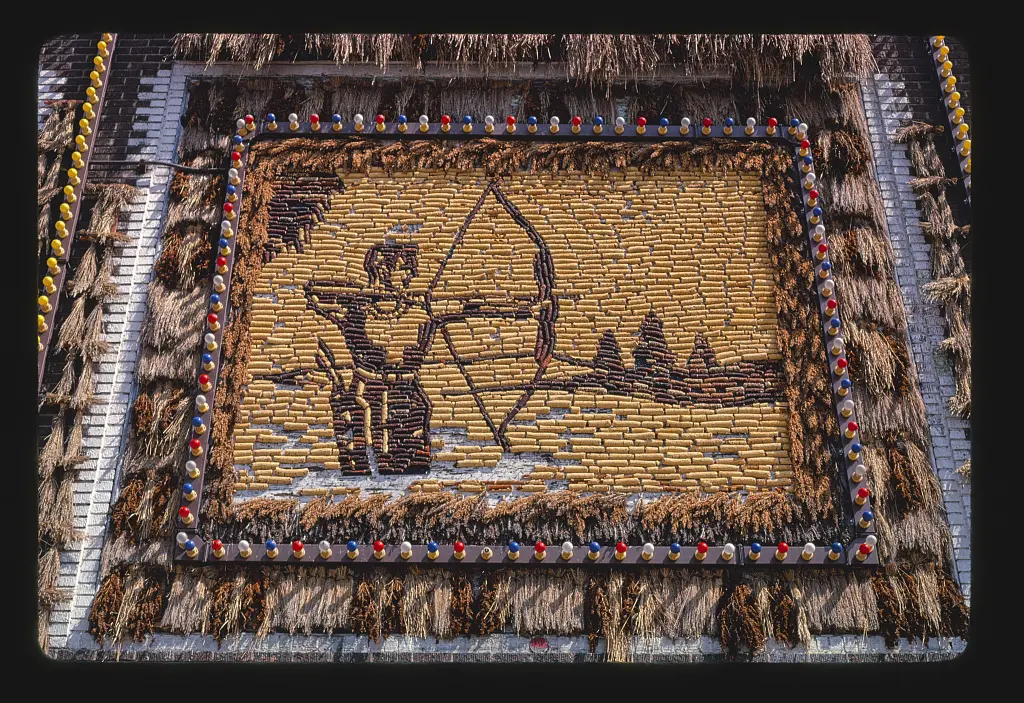
The official account describes the addition of Moorish-style minarets and kiosks in the 1930s. It also explains the practice of creating changing exterior murals from naturally colored corn and other plant materials, fixing individual ears into designed scenes.[2] The relevant material is therefore neither paint alone nor an unworked harvest. It sits between farming and image-making, requiring someone to treat agricultural produce as a unit of color and texture.
It is tempting to place the Corn Palace among roadside oddities and leave the matter there. A closer reading offers a different scale of meaning. The spectacle directs attention toward ordinary agricultural work, then converts that attention into a public destination. Its excess is useful. A modest building might shelter the same event, but it would not make the same claim for Mitchell. The palace stages a city's relationship with its surrounding fields, using a material that can be renewed while the need for a place to gather endures.