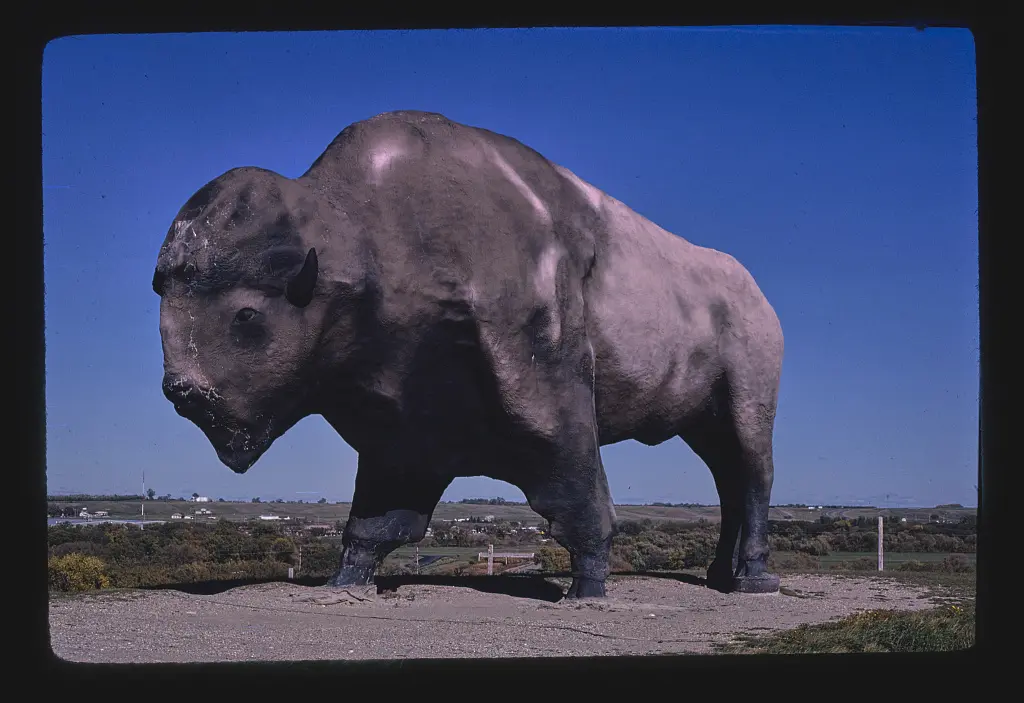
The Library of Congress identifies John Margolies’s 1980 photograph as the World’s Largest Buffalo in Jamestown, North Dakota.[1] The visitor bureau describes the monument as twenty-six feet high and sixty tons.[2] Those measurements belong to the attraction’s public identity. Size is not an incidental property here; it is the proposition through which the sculpture asks to be noticed.
Jamestown's official visitor bureau credits sculptor Elmer Petersen with creating the monument in 1959. Its account explains that a steel-and-wire framework supports a coating of sprayed cement, or gunite.[2] The enormous apparent animal is therefore an engineered shell, made from materials that allow a recognizable living form to be enlarged beyond life.
A roadside superlative offers a simple bargain. The visitor receives something easy to identify and recount; the town receives a point of distinction. The claim need not explain local government, industry, or daily life to establish an association between a place-name and a memorable object. That efficiency is powerful, though it also means the sculpture can become more widely recognized than the community it represents.
For decades the monument's descriptive title performed the work of a name. The visitor bureau records a naming contest in 2010 that received more than 3,500 entries and selected Dakota Thunder.[2] Margolies's photograph predates that decision by thirty years.
The naming episode reveals a change in the relationship between town and object. A superlative compares the sculpture with other possible sculptures. A personal name encourages attachment to this one. Neither eliminates the other, but the emphasis shifts from measurement toward character. The giant can become someone to greet rather than only something to measure.
Its construction provides another useful perspective. Steel, mesh, and cement are everyday building materials, yet their arrangement invites recognition of an animal. The effect depends on a maker's ability to select the features that will remain readable at an unusual scale. Excessive size does not remove the need for judgment; it makes that judgment more public.