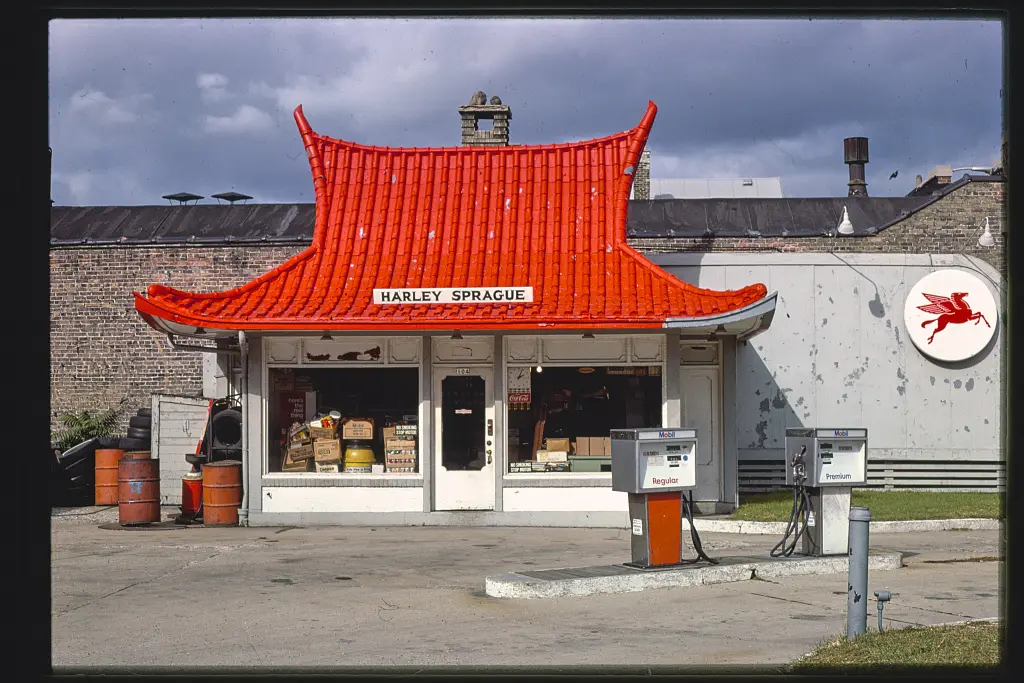
A pagoda roof could make a filling station recognizable before a driver read its name. John Margolies photographed the Harley Sprague station in Milwaukee in 1977.[1] The roof belonged to a commercial design that made the practical business of dispensing fuel conspicuous.
The Wisconsin Historical Society identifies this building as the Wadhams Oil Company or Clinton Street Filling Station and associates it with architect Alexander C. Eschweiler. Its inventory places construction around 1930. It was a separate property from the better-known 1927 Wadhams station in West Allis.[2][3]
The wider architectural connection is nevertheless important. In its account of West Allis, the society describes a regional chain of more than a hundred pagoda stations and explains how a dramatic roof distinguished a functional selling space. The roof carried a recognizable commercial identity above the ordinary business of dispensing fuel. A building could advertise before a customer had read its smaller lettering.[3]
The Sprague station's subsequent journey makes the distinction between image and structure unusually tangible. The inventory says the station was moved from 201 West Walker Street to 430 South Second Street. A note explicitly written in 2019 records disassembly in 2002, movement of the roof to the State Fairgrounds in 2004, its later demolition there, and retention of a roof portion in the society's museum collection. The record does not supply a precise date for that final demolition.[2]
This sequence resists a simple saved-or-lost caption. Moving a building can preserve its outline while breaking its relationship to a working site. Keeping a roof saves the element that made the business recognizable, but not the complete place where service occurred. Collecting a fragment creates yet another object: evidence that can be studied without recreating the experience of approaching a filling station.