A drive-in screen has two audiences. Moviegoers see the projected feature from inside the grounds; passing traffic encounters the structure's outward face. At San Antonio's Mission Drive-In, that public face acquired a history beyond the original film business.
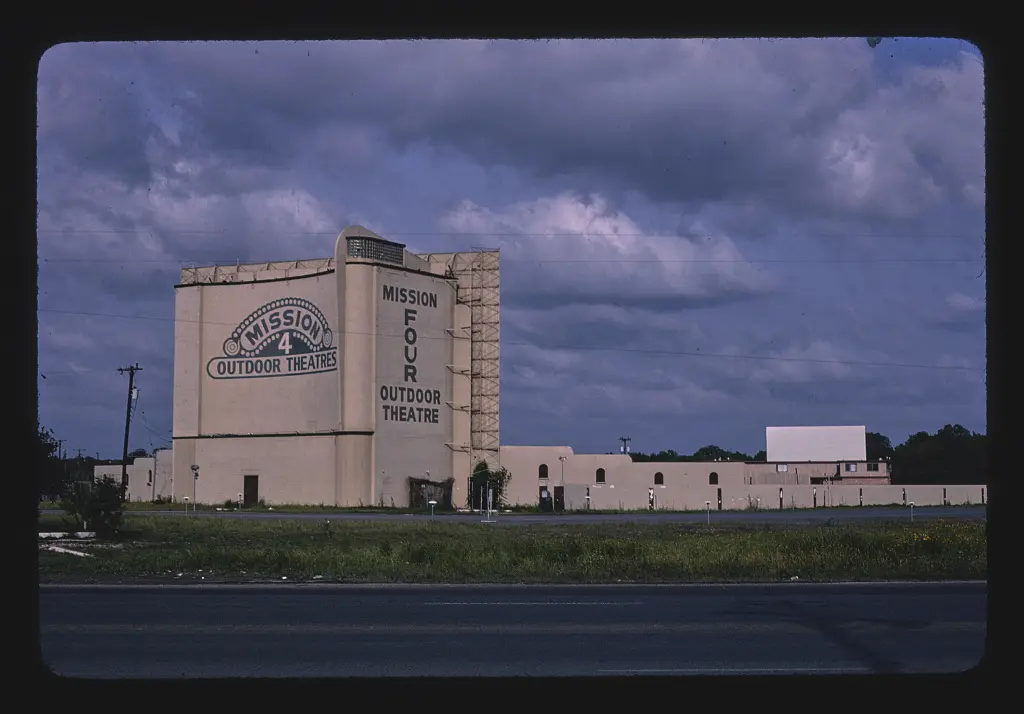
The theatre opened on March 27, 1948, with Pirates of Monterey.[2] Margolies photographed the Roosevelt Avenue site in 1982, more than three decades into its history.[1]
The drive-in turns the car into part of the auditorium. Viewers arrive with their own small enclosures, gathering before a shared screen rather than moving into rows of indoor seats. The tower has to serve that broad field of vision, making it a substantial presence even when no film is showing.
At the Mission, the marquee mural became a focus of later civic work. The City of San Antonio completed its Marquee Mural Re-Creation Project in January 2013.[2] Re-creation is the important word: the project involved a new act of making, not simply the uninterrupted survival of the original painted surface.
A commercial image had become something the city chose to carry forward. The mural could serve as memory, public art, and a marker of place after the conditions of movie-going changed. The screen's exterior reached people who were not necessarily customers of the theatre.
Margolies's earlier photograph provides a view of that identity before the later intervention. The building's roadside face was already available to a wider public than its audience of ticket holders.
The Mission's story follows this shift from attraction to remembrance. Architecture built around a temporary projection could leave a durable image in the city, and the outward face of a screen could become the part of a cinema that people chose to see again.