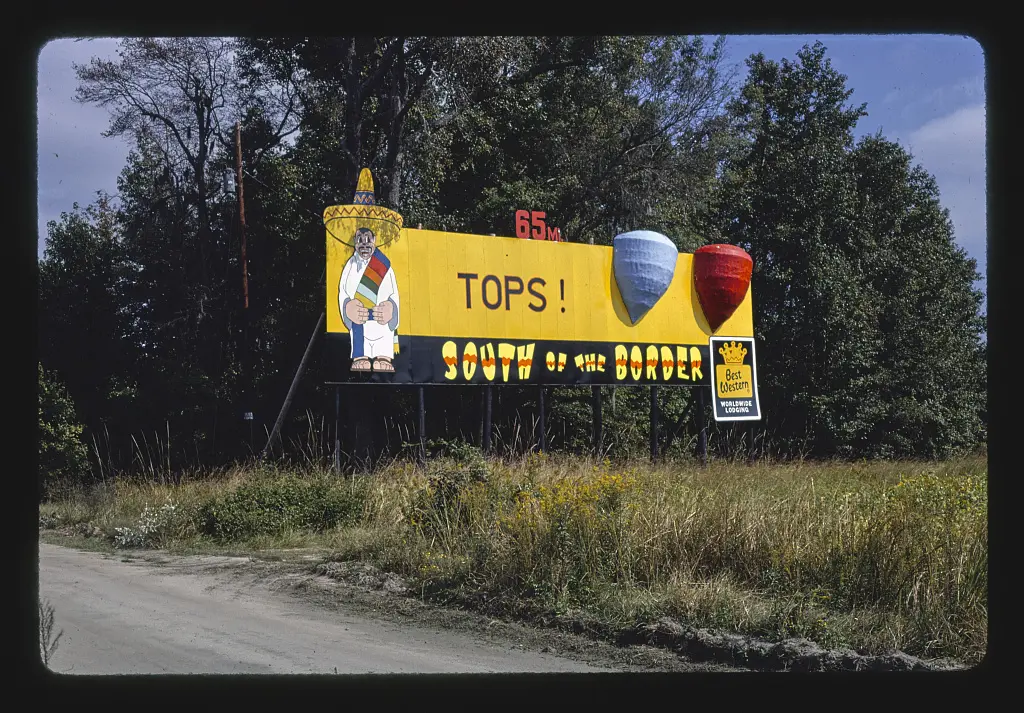
“Tops!” is the phrase preserved in the Library of Congress title for John Margolies's 1986 photograph of a South of the Border billboard near Dillon.[1] The brevity matters. Roadside advertising has little time to make its impression, and a memorable fragment can do more work than a full explanation. Here the business is encountered before the traveler reaches its buildings.
The Jewish Historical Society of South Carolina situates South of the Border in a regional history of immigrant merchants and family businesses. Its account identifies founder Alan Schafer as a native of nearby Little Rock. In the mid-to-late 1940s, restrictions on alcohol sales in a neighboring North Carolina county created an opportunity for a beer stand on the South Carolina side of the line.[2] Geography offered a commercial distinction before it offered a theme.
The same history describes the site's position near the north–south route connecting New York and Miami, later supplanted by Interstate 95. Schafer expanded into hotels, restaurants, shops, and amusement rides. His grandfather Abraham Schafer had been a general merchant in the area after immigrating from Germany.[2] The giant roadside enterprise thus has roots in a more intimate history of storekeeping and local settlement.
The name transforms a specific boundary into a much broader fantasy. Its immediate referent is the state line; its Mexican theme asks the visitor to imagine a different border altogether. That slippage is part of the advertising mechanism. It also deserves critical attention: a culture becomes a set of shorthand images through which a business markets leisure.
A billboard is a peculiar kind of architecture. It occupies land, addresses movement, and creates an expectation of another place. Repeated encounters can make an unseen destination feel familiar. Margolies's photograph isolates one instance of that process, allowing the short message to be considered as a designed object rather than merely a passing interruption.