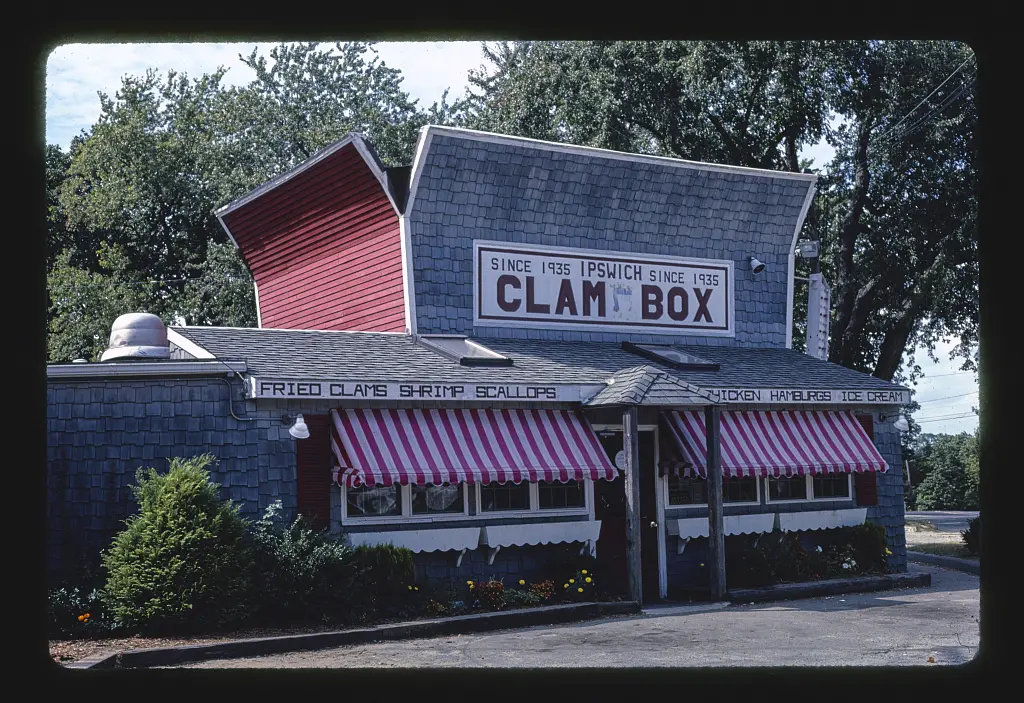
The Clam Box does not imitate a clam. It imitates the container in which a customer might carry clams away. That extra step makes the building an unusually precise piece of commercial imagination: it advertises not just food, but food already prepared for purchase. John Margolies's archive includes a photograph identified as the Clam Box in Ipswich, Massachusetts.[1]
The restaurant's official account dates the landmark to 1935.[2] Historic Ipswich provides a more detailed construction history, attributing the design to Richard J. Greenleaf Jr., who built it with help from his brother-in-law and a carpenter. The local history says the original material was Homasote, painted silver with red trim, and explicitly identifies a fried-clam box as the model.[3] The idea was direct; making a useful building from that idea required an additional act of translation.
Packaging has its own architectural qualities: edges, openings, folds, and the relationship between a shell and what it contains. Enlarging a package reveals those qualities. At the scale of a hand, the container is an incidental part of a meal. At the scale of a restaurant, it becomes the thing a traveler remembers and a business is named for.
Historic Ipswich also connects the early business with a family supply network: Mrs. Greenleaf's brother dealt in shellfish in nearby Rowley. It records the Greenleafs' sale in 1962 and the next owner's addition of a one-story dining room.[3] These details put ordinary commercial needs around the celebrated shape. Food had to arrive, customers had to be served, and additional seating could require space that the original novelty did not provide.
That expansion creates a useful distinction between the image of the business and the room it needs to operate. A highly recognizable central object can continue to anchor a place even when more conventional construction is added. The identity does not have to spread across every square foot. It needs to remain legible enough that a visitor can connect the parts.
The Clam Box also makes a curious claim about permanence. Its model is something cheap and temporary, normally discarded after use. Architecture gives the same outline a much longer public life. A fleeting part of consumption becomes a local reference point, capable of accumulating stories that an individual takeout box never could.