Crystal Pier offered a different relation to the ocean from a hotel facing the beach. Its cottages occupied the pier itself. Save Our Heritage Organisation dates the pier to 1927 and the introduction of overnight accommodation to 1930.[2] Part of a route over the water became a place to stay.
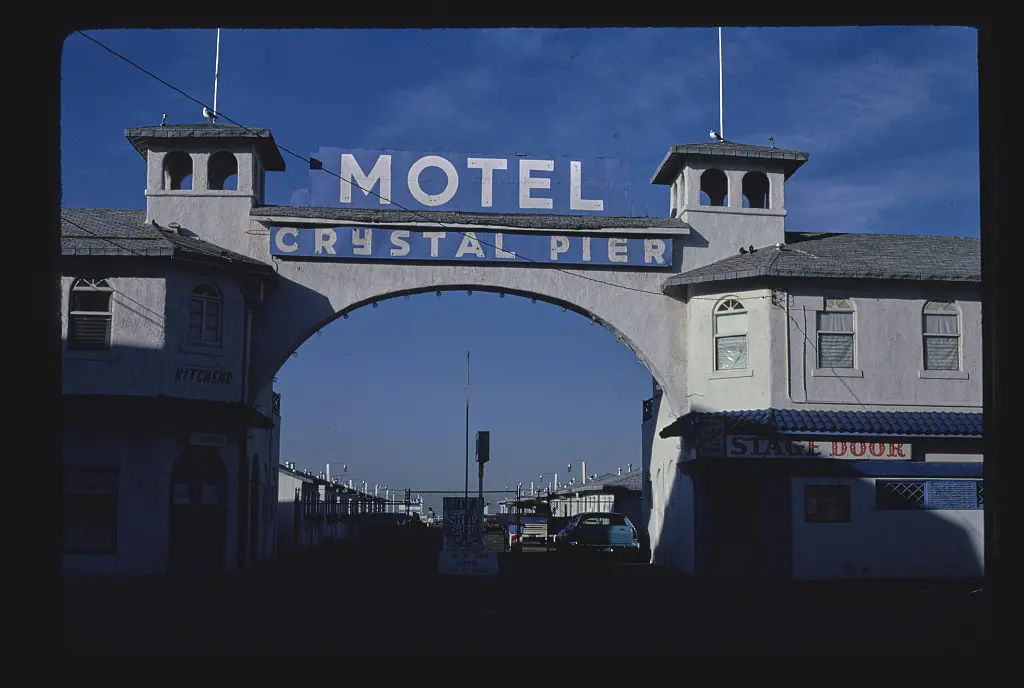
Margolies photographed the entrance to Motel Crystal Pier in Pacific Beach in 1985.[1] The entrance marks the transition between an ordinary land-based address and an unusual position beyond it.
A pier encourages outward movement: walk farther, leave the shoreline behind, look back toward land. Cottages interrupt that sequence with the possibility of remaining. The guest is offered more than a view toward the water; the accommodation belongs to the structure extending over it.
The preservation organization's account places the cottages within an earlier vision of beachfront entertainment.[2] Recreation and lodging were joined at the level of the site. The pier was both an attraction to visit and the basis of an overnight destination.
That arrangement gives the entrance particular importance. It must announce a business while also introducing a change in setting. The threshold is where road travel meets the experience the property promises.
Crystal Pier broadens the motel story beyond the highway shoulder. A motor traveler could be drawn to an existing attraction whose landscape made the stop memorable. Here, distinctiveness depended less on a room's novelty than on where the room was placed.
The 1985 image catches that proposition at its point of entry. Street, accommodation, and pier converge in a single address. What would usually be an endpoint for a walk becomes the beginning of a stay, turning coastal infrastructure into a form of hospitality.