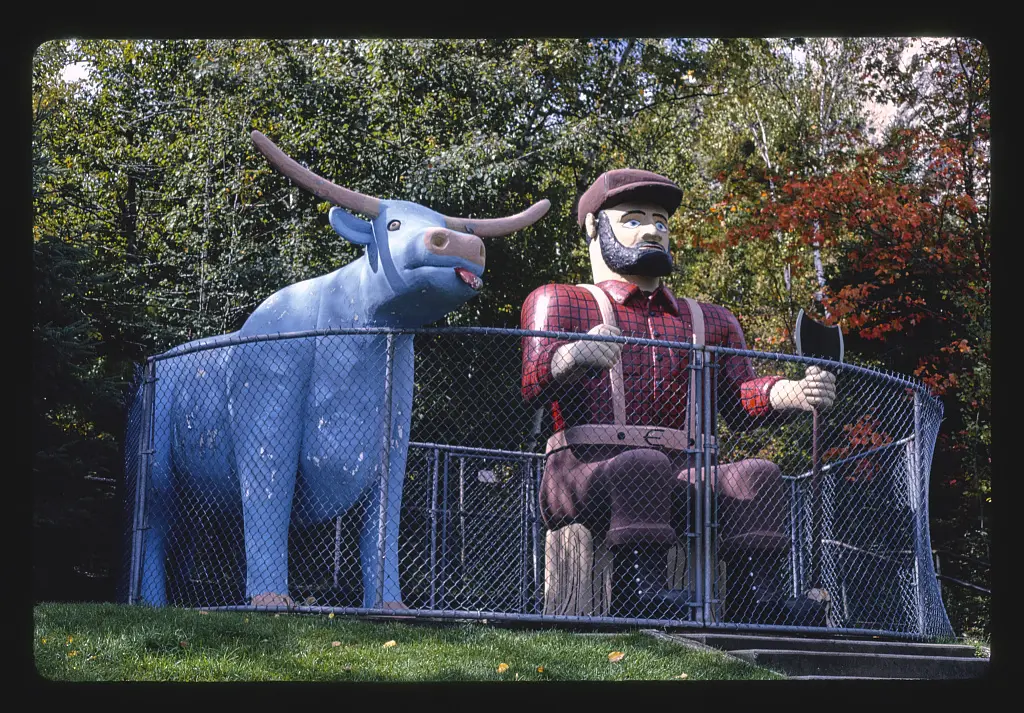
John Margolies's 1988 photograph at Castle Rock identifies Paul Bunyan and Babe beside Interstate 75 near Saint Ignace.[1] The title gives the attraction two scales of recognition: a specific Michigan lookout and figures large enough to compete for attention within that setting. A natural destination was accompanied by an explicitly made one.
Castle Rock's official account promotes views toward Mackinac Island and Lake Huron and invites visitors to pose beside Paul and his blue ox. It also describes a gift shop with birch-bark walls and ceiling, which it attributes to local Native American craftspeople in the early 1950s.[2] These are different kinds of encounter—looking outward, standing beside a figure, and entering a crafted room—assembled into one stop.
The juxtaposition is more revealing than a simple division between nature and kitsch. A lookout already organizes the landscape for viewing: a person is brought to a particular position and invited to see a panorama. A roadside giant organizes another kind of view, often one that includes the visitor. The first makes a picture of the region; the second offers a picture of oneself having been there.
Paul and Babe give the stop a narrative scale: the landscape becomes a setting in which outsized characters seem imaginable. The attraction's invitation to take a photograph makes their role practical as well as decorative. They offer a recognizable subject around which a personal memory can be composed.[2]