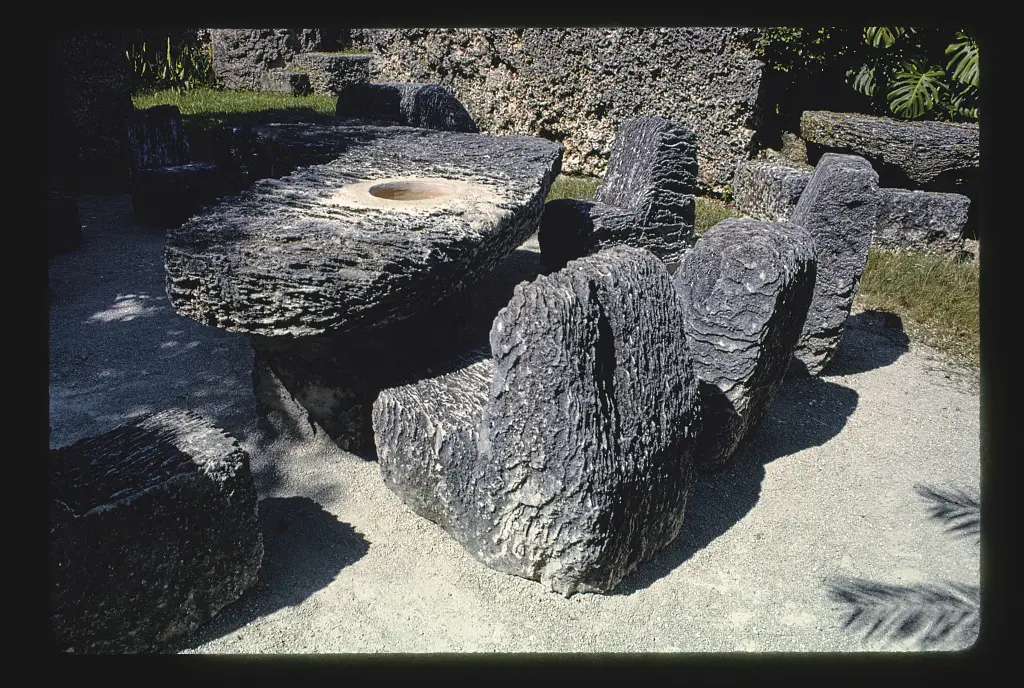
“Castle” suggests a fortified residence; “coral” suggests something grown in the sea. Coral Castle's documented history points instead toward an open-air sculpture garden and the sustained work of an individual maker. John Margolies photographed the attraction on Route 1 near Homestead in 1990.[1]
The National Register nomination identifies the site by the earlier names Rock Gate and Ed's Place. It describes large oolitic limestone sculptures and dates the beginning of construction to 1923. Some pieces were first assembled at a Florida City location, then moved in 1937; other sculptures were made at the Homestead site.[2] The apparently immovable material had a history of relocation.
That move gives a useful sense of the maker's commitment. A stone object may appear permanent once it stands in a garden, yet its position is the result of decisions and effort. Leedskalnin's garden was an accumulation, transferred and extended over time.
The museum's own account identifies the creator as Edward Leedskalnin, a Latvian immigrant without formal architectural or engineering training. It emphasizes his quarrying, cutting, carving, and use of self-made tools. The same account presents stories about mysterious or supernatural building powers.[3] Those stories are evidence of the attraction's promotional language, not proof that supernatural methods existed.
The site also complicates the boundary between private expression and public attraction. A maker's personal arrangement can become a destination once others are invited to enter and interpret it. Visitors may arrive for a mystery and leave thinking about labor; another viewer may focus on the shapes or on the relationship between objects and open space. The historical name Ed's Place makes that personal dimension especially direct.