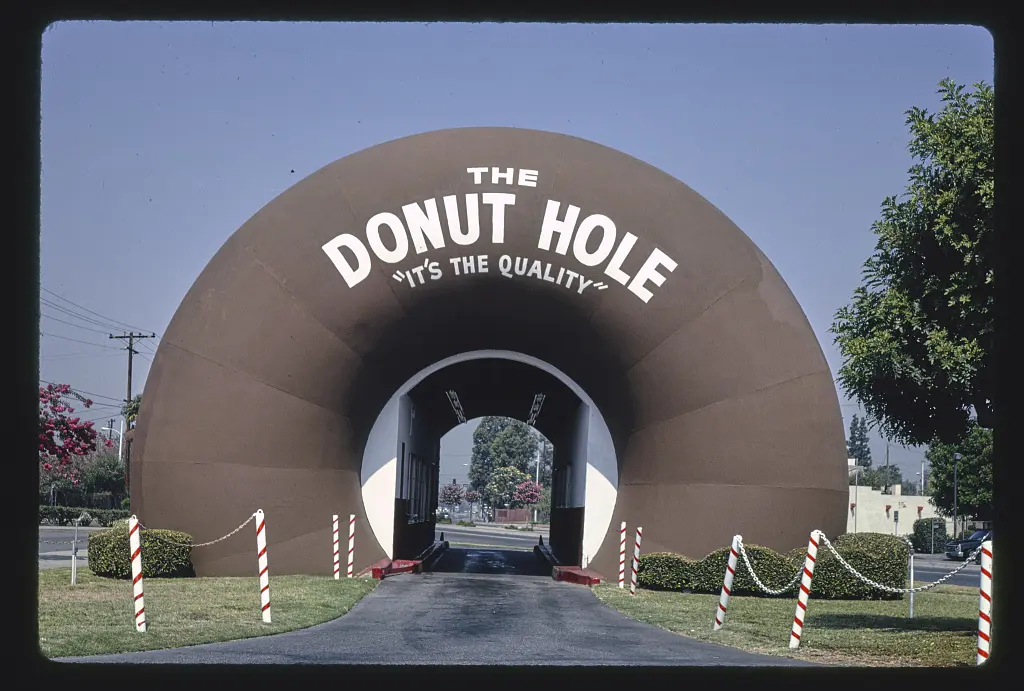
At the Donut Hole, the missing part of the product becomes the useful part of the building. Customers drive through the centers of two giant fiberglass doughnuts, entering a passage between the shop's two halves to order and collect food.[2] Advertisement and circulation plan are the same device.
The Los Angeles Conservancy dates the La Puente building to 1968. It was the second of five Donut Hole locations, but the only branch that incorporated doughnuts into its architecture.[2] A shared business name received a particularly literal expression at this address.
Margolies's 1991 catalog title specifies a straight-on view without cars on Amar Road.[1] The empty passage lets the design explain itself. The opening is not a decorative hole in a sign; it is a route through the business.
The scale change is the source of the humor. A small snack becomes a gateway large enough for a car, and the customer moves inside the representation of the thing being sold. The doughnuts identify the product before anyone reads a menu, while their placement directs the transaction.
The Conservancy classifies the shop as Programmatic architecture.[2] At La Puente, that term describes more than resemblance. The building does not simply look like food; it recruits the food's geometry to organize movement.
The branch's distinctiveness also shows how much variation can exist beneath a chain name. The other locations shared an identity, but this one made that identity spatial. Its familiar circles became a sequence—approach, enter, order, leave—rather than a symbol attached to an otherwise ordinary wall. Margolies's car-free view gives that sequence a moment of stillness, allowing the opening itself to become the subject.