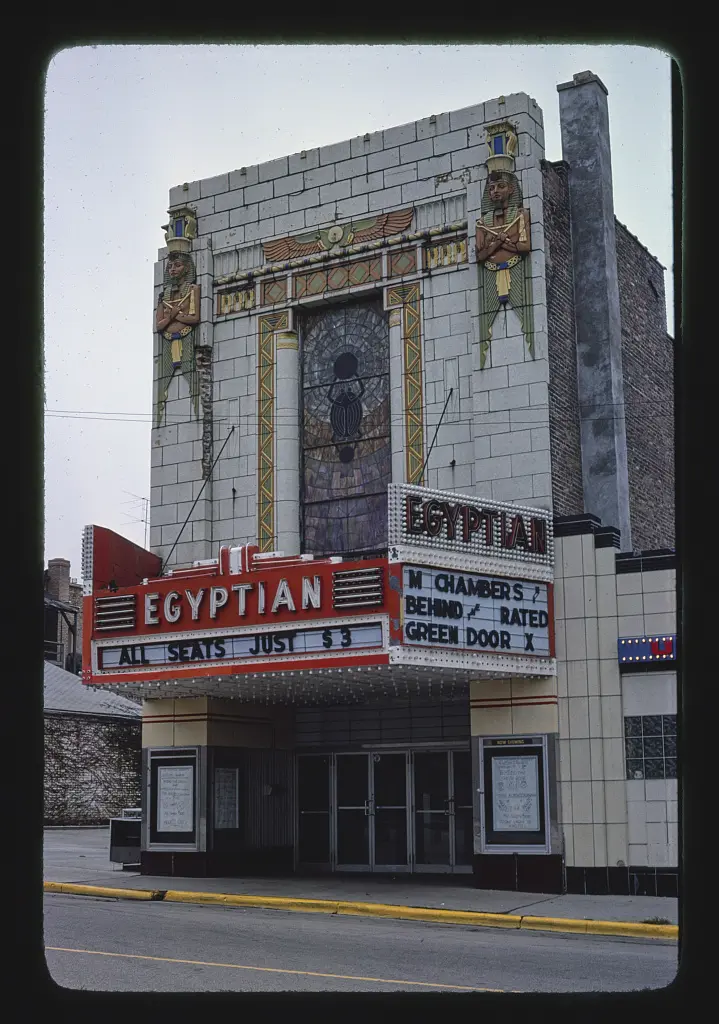
An Egyptian theatre in an Illinois town is already a kind of journey. Before a movie begins, the name offers passage to a distant place and time. John Margolies included DeKalb's Egyptian Theatre in his roadside archive; the Library of Congress photograph preserves the building as part of the everyday commercial landscape rather than separating it into an exotic category of its own.[1]
The theatre's institutional history connects its design to the enthusiasm for ancient Egypt following the discovery of Tutankhamun's tomb in 1922. In 1928 the DeKalb Theatre Company sought a larger venue for motion pictures and vaudeville and consulted Chicago architect Elmer F. Behrns. Construction followed in spring 1929, and the theatre opened on December 10 that year.[2] Archaeological discovery had become a vocabulary for selling modern entertainment.
That translation deserves attention. The theatre did not transport ancient Egypt intact into DeKalb. It selected an imagined Egypt that could function as spectacle. In that sense the building belongs to the same world as a film set: architecture prepares an audience to suspend the ordinary conditions of daily life. The experience begins on the street, where a name and a designed exterior can make the coming performance seem larger than the room that contains it.
The opening also occurred at a sharp economic turning point. The official history says the October 1929 stock market crash prevented additional planned buildings, including a hotel. The lobby's broken-tile floor replaced an intended marble treatment.[2] These details place limits and compromises inside the glamorous image. A theatre can promise abundance while its construction history records decisions about what could actually be afforded.
Later preservation treated the building as an asset for community use. A DeKalb County visitor bureau history identifies the nonprofit Preservation of the Egyptian Theatre as its owner and records National Register recognition in 1978.[3] Preservation here concerns more than holding a facade still. A performance building needs audiences, working rooms, and reasons for people to return; otherwise its outward promise loses its practical purpose.