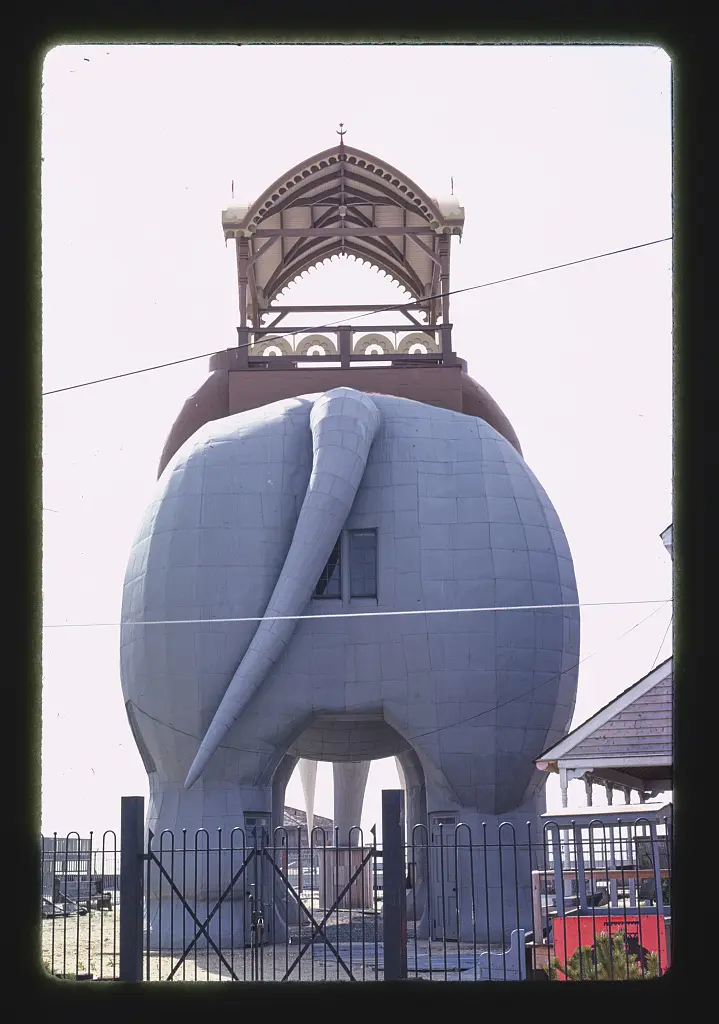
An elephant makes a peculiar building because it forces two ways of looking to coexist. We recognize an animal, then have to reconsider its body as a set of spaces that people can enter. John Margolies photographed Margate City's elephant in 1978; the Library of Congress preserves the image under the straightforward title “Margate elephant.”[1]
The Save Lucy Committee dates the original Elephant Bazaar to 1881 and identifies Philadelphia developer James Lafferty as its builder. It describes a sales attraction for prospective buyers of land in what was then South Atlantic City. Visitors could arrive by railroad. Lucy therefore complicates the convenient idea that novelty architecture began with the motorist: this enormous advertisement belonged to an earlier transportation landscape.[2]
A conventional sign can describe a destination; an inhabitable elephant makes arriving there an event. The building offers a reason to stop that is separate from the land being sold. Its animal form gives the promotion a memorable identity, while its interior converts looking into participation.
Lucy also acquired a second kind of value. According to the committee's chronology, the Gertzen family donated the elephant in 1970, when it was moved and restoration began. It reopened in 1974 and received National Historic Landmark designation in 1976. Margolies's 1978 photograph thus belongs after an organized rescue, not simply to an untouched remnant of Victorian commerce.[2]
Preservation was material work. The New Jersey Historic Trust records assistance for repairs to the observation pavilion on Lucy's back, moisture damage within the body, and later cladding assessment and replacement. Its grant history includes awards in 2019, 2020, and 2022.[3]