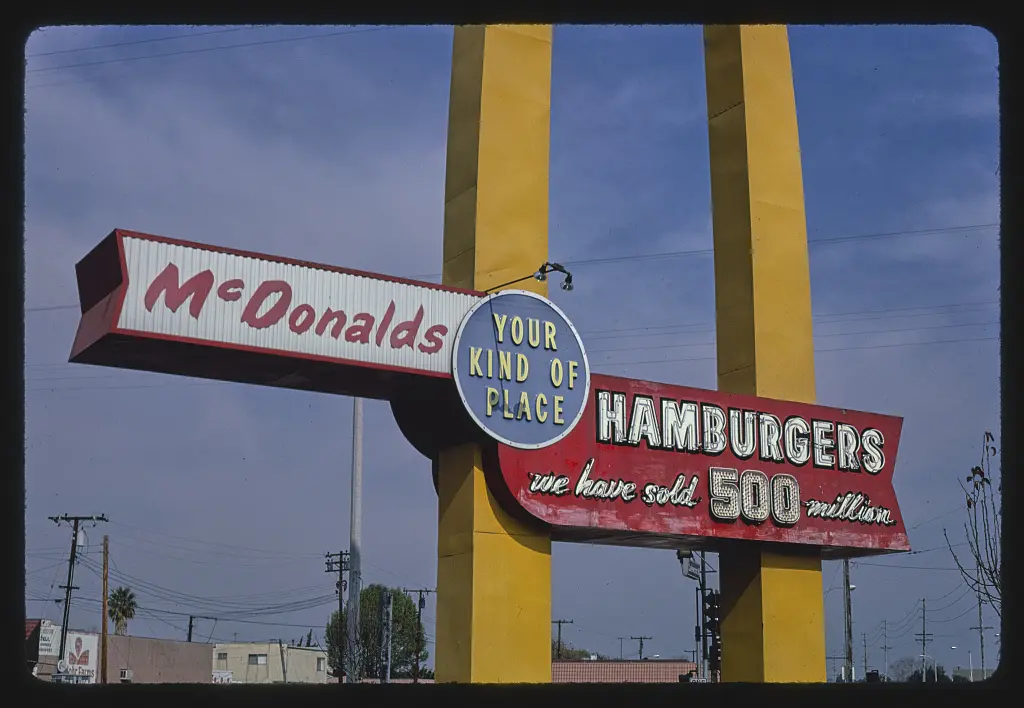
Downey's McDonald's became rare by remaining familiar. Its early restaurant design survived while the corporation replaced or remodeled similar stands elsewhere. The Los Angeles Conservancy identifies the Lakewood Boulevard building as Stanley Clark Meston's 1953 Googie design.[2]
The branch's unusual franchise history helped preserve it. Its agreement originated with the McDonald brothers, rather than the later corporation, allowing the earlier form to persist as corporate requirements changed.[2]
Margolies photographed a detail of the sign in 1985.[1] His attention places an everyday commercial emblem within an architectural archive. What had been designed for repetition was becoming evidence of an earlier version of the brand.
When the restaurant closed in 1994, the Conservancy and Downey Historical Society organized a preservation campaign. Rallies and publicity helped make its future a public issue. The restored restaurant reopened in December 1996.[2]
The campaign complicated a familiar opposition between local character and chain commerce. This was a repeated design, yet one specific example had acquired a local history. Its familiarity made it easier for people to recognize what would disappear if the building were replaced.
A company sign can thus carry two identities at once. It promotes an ongoing business, but it can also preserve a moment in that business's changing visual language. The old version becomes historically legible when newer versions surround it.
Margolies's photograph predates the preservation dispute. It records the sign before the later campaign gave the place another meaning. Read with that history, the image shows how an ordinary part of car culture could become a preservation cause: a widely recognized brand anchored in a particular building, on a particular corner, with a design people wanted to keep.