Pepperdine's Los Angeles campus has an unexpected place in the history of the automobile. Its founder, George Pepperdine, established Western Auto Supply Company in 1909. The success of that retail business supplied the fortune with which he endowed a Christian college.[2]
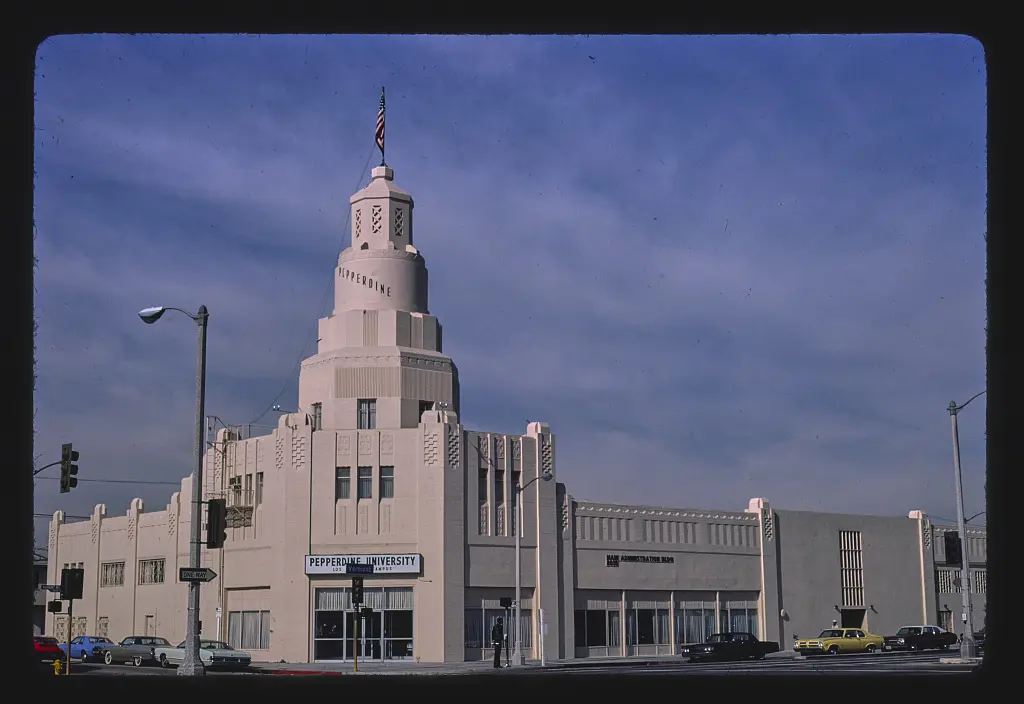
George Pepperdine College opened on September 21, 1937, on a former estate in Vermont Knolls. Residence halls, an administration building, and a dining hall rose in Streamline Moderne forms, painted the light blue later associated with the campus.[2] The institution's beginning joined automobile commerce, religious conviction, and a deliberately modern architectural setting.
Margolies photographed the campus at 81st Street and Vermont Avenue in 1977.[1] By then, the university's first students had already entered its Malibu campus, in September 1972.[2] His image preserves the earlier Los Angeles address at a moment when the institution's geography had expanded.
The connection to Western Auto does not make the campus a disguised car advertisement. It reveals a less direct way the automobile economy shaped the built environment: retail earnings could become classrooms, residences, and an institutional home. A fortune accumulated through motorists' purchases acquired a new public expression.
The street address is important to that story. A university can become identified with one celebrated view while its earlier setting recedes from public memory. This photograph keeps the Vermont Avenue campus visible on its own terms, rather than as a footnote to Malibu.
Among Margolies's commercial subjects, the campus broadens the meaning of roadside America. The buildings encountered along a city street can connect to motor travel through financing, philanthropy, and the movement of institutions as well as through their immediate function.