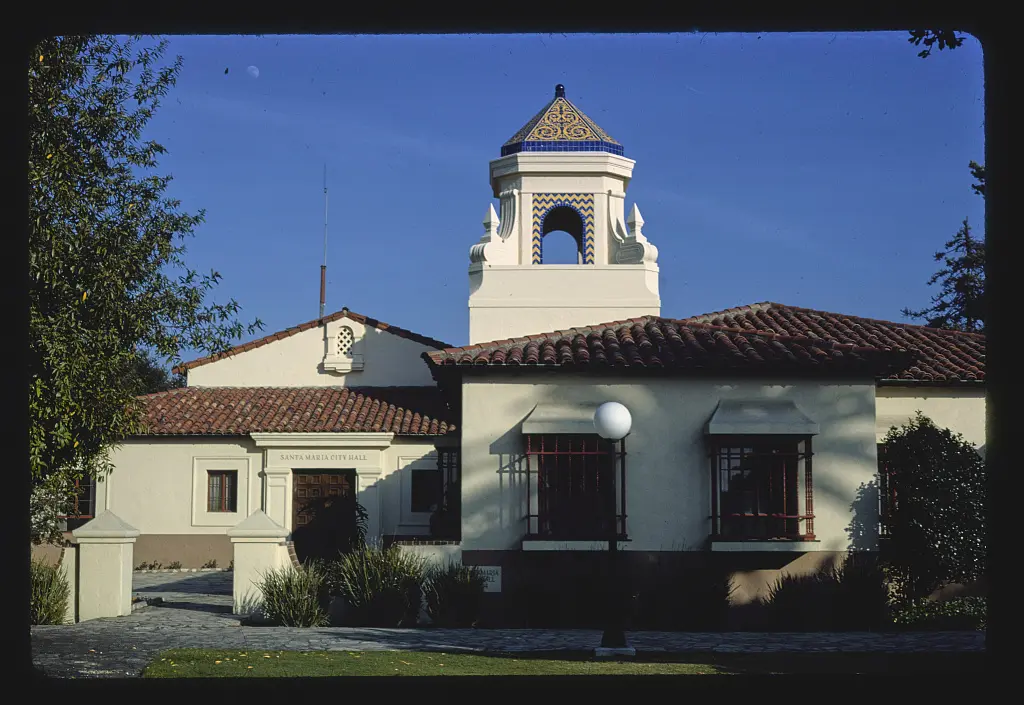
Santa Maria began 1934 by breaking ground for its first city-owned municipal building. The new City Hall was dedicated that September, according to the Santa Maria Valley Historical Society's chronology.[2] A building that later became a familiar part of Broadway and Cook Street began as a specific public undertaking.
The timing gives the project weight. The society's nearby entries record the banking emergency of 1933 and an agricultural strike in November 1934.[2] City Hall opened amid economic strain, not in an uninterrupted period of municipal prosperity. Its completion placed a durable civic address within an unsettled local economy.
Margolies photographed the Broadway and Cook Street building in 1977.[1] The intersection anchors the image in the daily life of the city. A municipal building is both a place where government operates and a marker by which residents and visitors understand the center of town.
The first city-owned hall also represents a change in how a municipality houses itself. Ownership gives an institution a physical home around which routines and expectations can accumulate. The building can become familiar to people who never attended its dedication and know little of its construction.
That gradual familiarity is part of what the later photograph preserves. The 1934 project had become a settled feature of the street by the time Margolies recorded it. Its place in the archive asks us to look again at architecture whose significance can be obscured by habitual use.
Alongside novelty restaurants and roadside signs, City Hall tells a complementary story. The built landscape of travel includes the places a community makes for its own affairs. Santa Maria's hall expresses that local investment: a permanent public address established during a difficult year, then absorbed into the ordinary geography of the city.