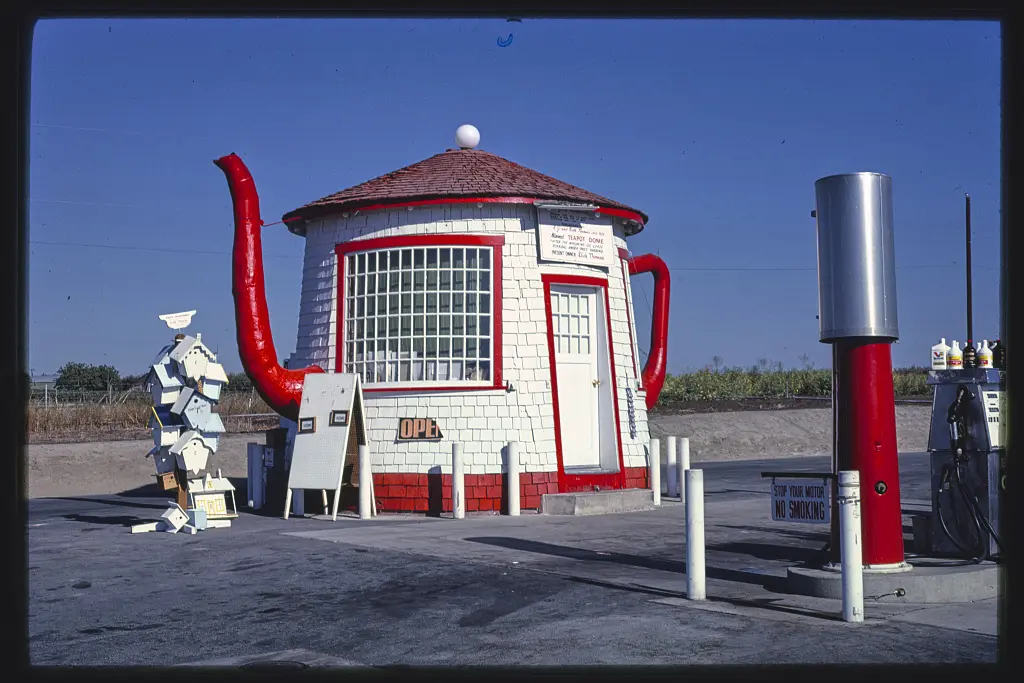
A white teapot with a red lid offered an unlikely place to buy gasoline. Its handle and spout made the sales pitch instantly legible, but its name carried a sharper joke. Jack Ainsworth built Zillah's Teapot Dome Service Station in 1922 as a response to the oil-lease scandal involving Wyoming petroleum reserves and the Harding administration.[2]
The connection between form and business is unusually pointed: a scandal about petroleum became the identity of a petroleum retailer. Drivers could enjoy the oversized household object without knowing the political reference. Those who recognized the name received a second message. Ainsworth had turned a national news story into a local landmark.
The station attracted people who posed for photographs and bought postcards.[2] The building's image became another thing that could travel. Margolies joined that longer history of looking when he photographed it in 1987.[1]
Zillah was more than a setting for a novelty. Founded in 1892 and incorporated in 1911, the town developed as a commercial and residential center for the irrigated Yakima Valley. Orchards and rail connections shaped its growth.[2] The teapot belonged to this working landscape of agricultural production and transport.
Its power as an advertisement lies in how little explanation its outline needs. A domestic object becomes a building, the building becomes an address, and the address remains recognizable after the topical joke grows old. The political reference gives the station specificity; the simple silhouette gives it reach. Both help explain why a small roadside business could become one of the most memorable structures in a town.