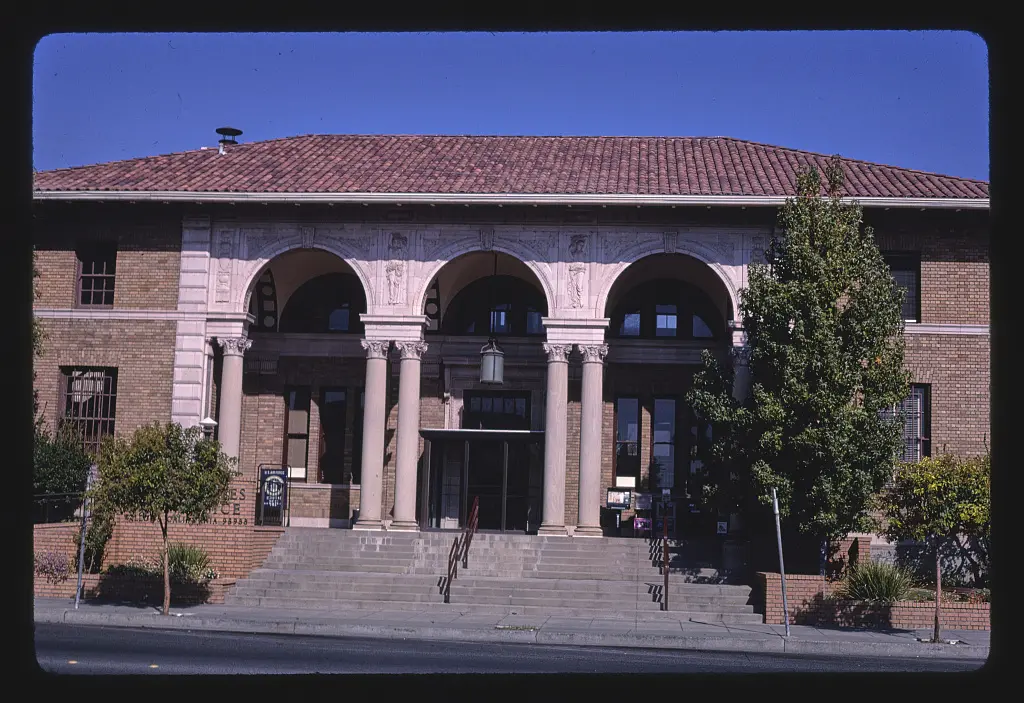
The Willows post office gives an ordinary errand a ceremonial approach. A central arcade, terracotta ornament, and a red tiled roof lend a relatively small building the bearing of a public monument. Its National Register nomination describes the combination as Italianate forms with Beaux-Arts detail.[2]
The government acquired the West Sycamore Street site in October 1914. The building, designed by San Francisco architects Bliss and Faville, was occupied in September 1918.[2] Margolies photographed it in 1987, placing a civic building among the businesses and attractions of his roadside survey.[1]
The design works through proportion and repetition rather than through a giant sign. The arcade marks the threshold; the ornament concentrates attention around the public face. A visit lasting a few minutes takes place within an architectural language associated with permanence.
The 1984 nomination also records practical changes: an accessible ramp, a new entrance vestibule, and alterations to the loading area.[2] These additions belong to the building's history as a working post office. Its monumental ambitions did not remove the need to accommodate deliveries, entry, and changing expectations of access.
One question remained open in the nomination. Its authors called for further contract research to explain the circumstances of employing a private architectural firm.[2] The attribution to Bliss and Faville is clear; the administrative path to that commission is less so.
On Sycamore Street, the post office supplies a different kind of roadside distinction from a motel or restaurant. It asks to be recognized as a dependable public address. In Margolies's archive, it shows how a street's identity can be made by the buildings where routine civic life happens, as well as by the places competing for a traveler's money.