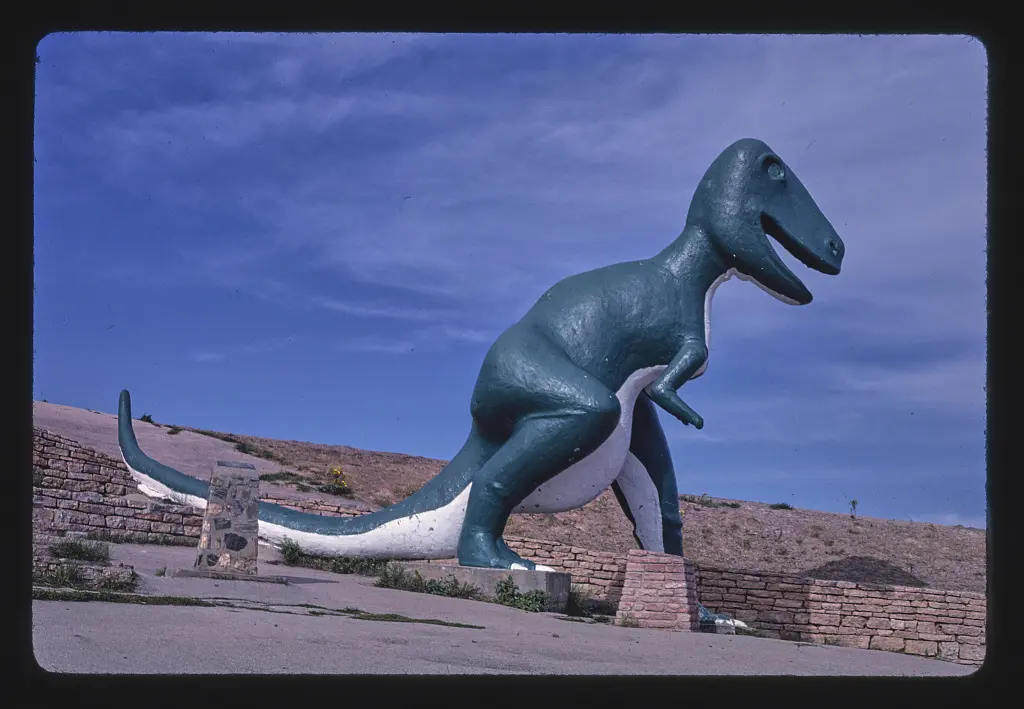
John Margolies photographed a Tyrannosaurus at Rapid City's Dinosaur Park in 1987.[1] The animal belongs to an unlikely category of public work: an invented prehistoric presence, built to draw people into a modern city's landscape. Its history is as much about employment and civic ambition as it is about dinosaurs.
The National Register nomination dates the beginning of work to February 1936 and describes a project substantially complete by the middle of 1938. Sculptor Emmit A. Sullivan directed the work, with support from the Works Progress Administration. The nomination identifies five original sculptures and distinguishes them from two later, smaller additions.[2] The park was a coordinated undertaking rather than a collection of unrelated roadside objects.
The same document connects the project with Skyline Drive. The road began under the Federal Emergency Relief Administration and was completed by the WPA, including retaining walls, supports, and a gravel roadbed. It also describes consultation from paleontologist Barnum Brown of the American Museum of Natural History.[2] Access, engineering, scientific information, and sculpture all contributed to the visitor's eventual encounter.
This combination makes the park a useful reminder that spectacle requires infrastructure. A giant animal may dominate a photograph, but people need a way to reach it. Work on a road can be visually modest while making the dramatic object possible as a destination. The attraction and its approach were linked parts of a larger public project.
The dinosaurs also translate specialized knowledge into bodily scale. Fossil evidence can be difficult to imagine as a living creature; a sculpture offers an immediate comparison with one's own size. That does not make every reconstruction timelessly accurate. It makes the park evidence of a particular effort to give prehistoric life a public form.
There is a second scale at work in the history: the size of the city's ambition. Choosing dinosaurs for a public attraction asserts that local tourism can be made, not merely inherited. The figures provide a reason to climb, stop, and look. They also create an image that can circulate beyond the people physically present in the park.