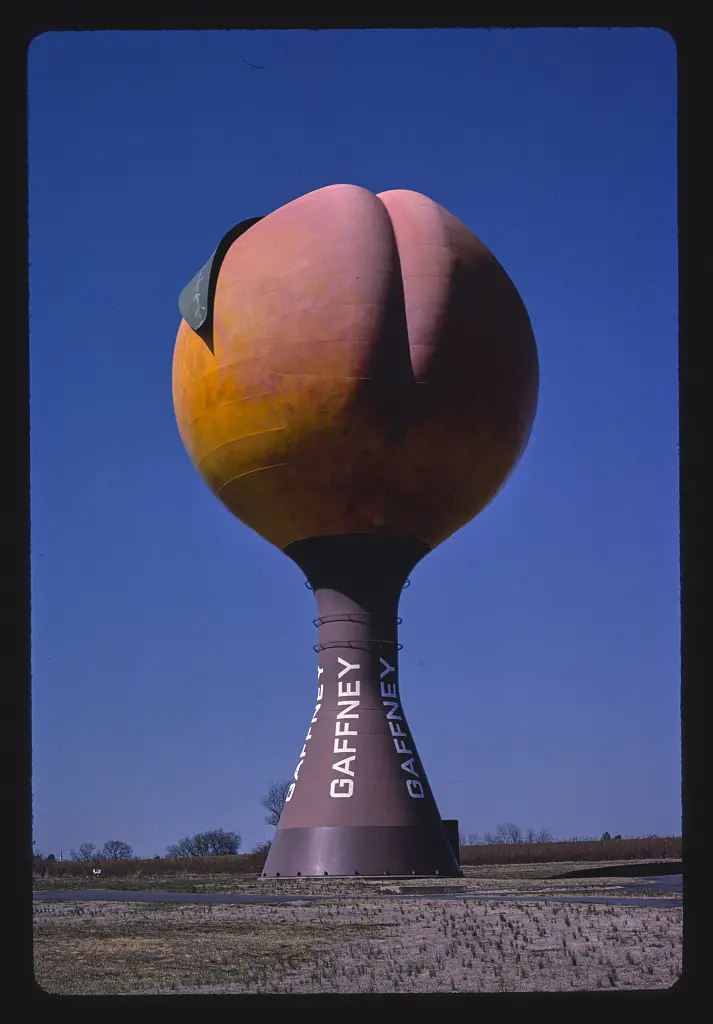
A peach is mostly water, but that is not quite the explanation for Gaffney's enormous example. This fruit is also a tank. The practical and representational purposes occupy the same volume: infrastructure has become an image of the region that commissioned it. John Margolies photographed the peach water tower from Frontage Road in 1988.[1]
The Gaffney Board of Public Works dates construction to 1981, following a study that identified the need for additional elevated storage. Commissioner Jack Millwood proposed making the new tank resemble a peach to acknowledge the area's growing heritage. The board's account names Chicago Bridge & Iron as the construction company and Peter Freudenburg as the artist who painted it, matching colors to peach varieties historically grown in Cherokee County.[2]
That sequence matters because it begins with a public utility requirement. The Peachoid was not merely a sculpture to which a useful function was later attached. A necessary structure received an additional job: making a place recognizable. The choice avoided the separation between a municipal tank and a nearby welcome sign. It let the reservoir itself carry the introduction.
The relationship between scale and recognition is unusually direct. A piece of fruit belongs in a hand; an elevated tank belongs above buildings and roads. Combining them creates a brief uncertainty about what one is seeing. Once understood, the familiar form does the work of a longer explanation. It offers an easily remembered connection to agriculture without asking a passing traveler to read a detailed account of cultivation.
A 2024 South Carolina ETV program treated the Peachoid alongside other state roadside attractions and gave its height as 135 feet. That broadcast demonstrates its later reception as a travel landmark.[3][2]
The Peachoid suggests that commercial-looking spectacle need not be commissioned by a private restaurant or motel. Public infrastructure can compete for attention too. Here the object being promoted is less a product for immediate purchase than an association between a town and a crop. Its place in the archive expands roadside advertising from the invitation to buy something to the invitation to remember somewhere.