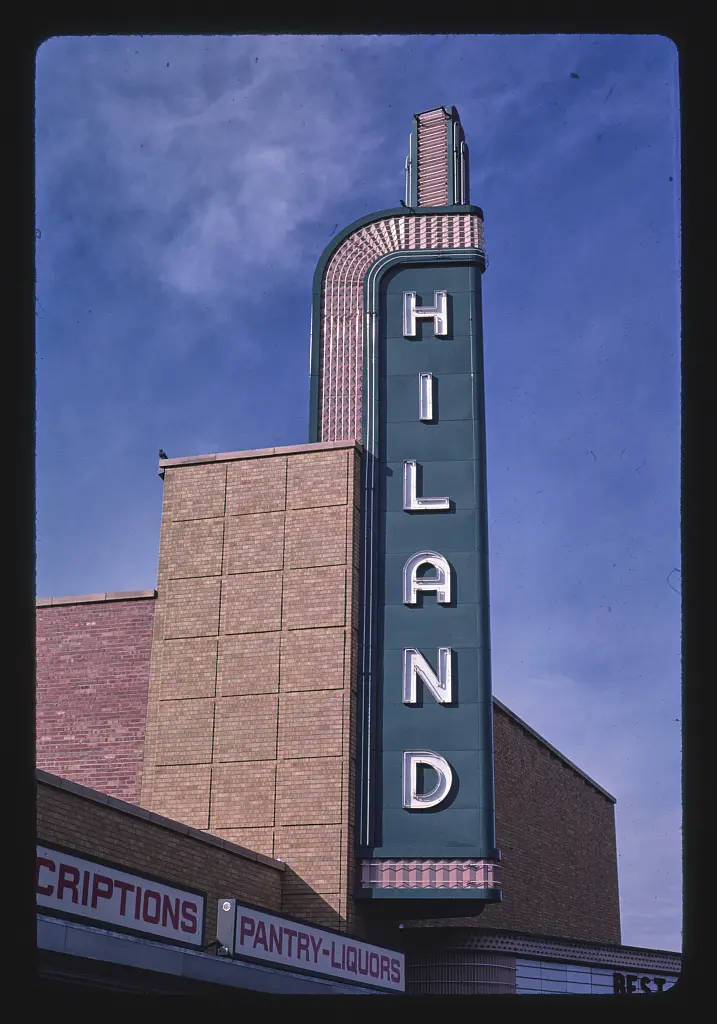
The Hiland opened in 1950 with 1,188 seats and a garage behind the building for 350 cars.[2] Audience and automobile were both accounted for in the design. Albuquerque's Central Avenue movie house organized a substantial evening's gathering on Route 66.
Margolies photographed the Hiland in 1987.[1] At that point, the building's later identity as a home for dance education lay ahead.
NDI New Mexico and Bernalillo County began a partnership to revitalize the property in 2009. Renovation created eight dance studios, offices, and a 600-seat theatre that could also be divided into studio space.[2] The building shifted from a place primarily arranged for watching performance to one supporting the work of making it.
The change involved more than reducing the number of seats. Rehearsal and teaching require space used repeatedly throughout the day, rather than an auditorium occupied around a screening schedule. Students need room to practice, return, and improve. A theatre's existing association with performance offered a useful starting point, but its internal organization had to serve a different rhythm.
That adaptation gives the Hiland a history beyond the replacement of one entertainment fashion by another. The project found a new purpose within an established public address. Some parts of the old idea—gathering, movement, an audience—remained valuable even as the activities changed.
The relationship to the road changed with them. A venue built to receive large numbers of moviegoers and their cars became an educational destination. Margolies's photograph preserves the familiar outward identity before that conversion, a point of continuity between two ways of using the same building: watching moving images and learning to move before other people.