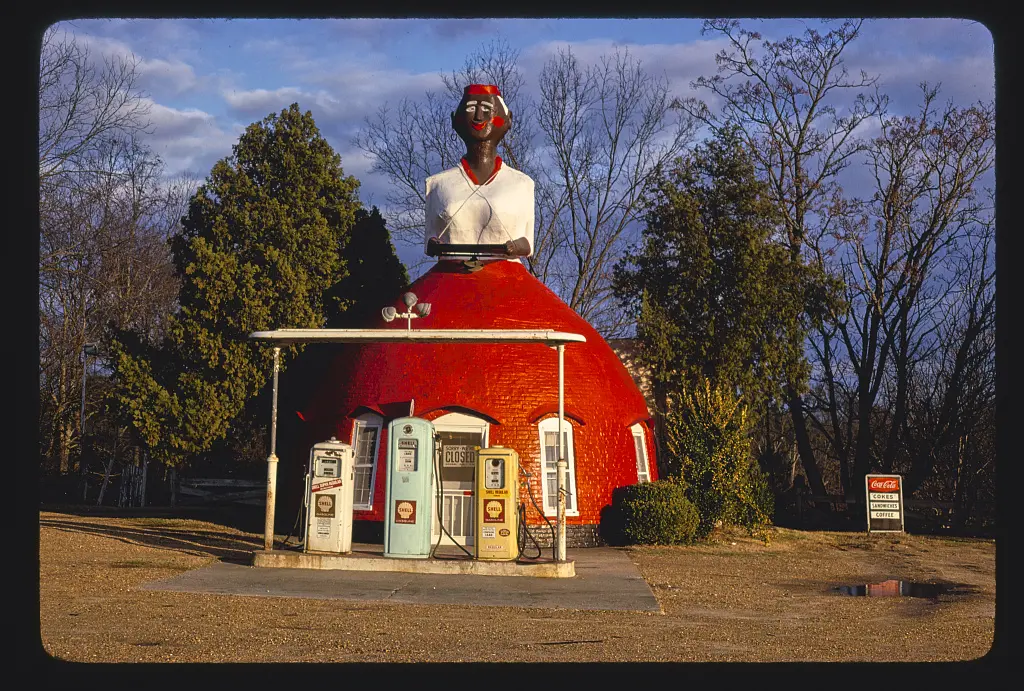
A human-shaped restaurant can attract attention through scale alone. Mammy's Cupboard requires a more difficult reading because the figure is also a racial stereotype. The Library of Congress identifies John Margolies's 1979 photograph as an angled view of the restaurant on Route 61 near Natchez.[1]
Ferris State University's Jim Crow Museum describes the “mammy” figure as an enduring caricature of African American women. In its historical account, the stereotype represented a supposedly contented, loyal domestic worker whose devotion to a white household helped disguise the violence and exploitation of slavery and segregation. The museum documents its circulation through advertisements, household goods, souvenirs, and other everyday objects.[2] Familiarity was part of the caricature's power, not evidence of its innocence.
The Natchez restaurant gives that representational problem an architectural scale. A figure associated with cooking and service becomes the image through which a business invites customers to eat. A preservation essay by Thomas Rosell uses Margolies's photograph of the building to discuss the architectural distinction between a building shaped as its symbol and a conventional building carrying applied signs.[3] That formal analysis is useful, but it cannot exhaust the subject.
The question is not only how efficiently the shape communicates. It is also what has been made to seem welcoming, whose labor supplies that promise, and which viewers are expected to feel at home with it. The promise of hospitality was carried by an image that concealed the unequal terms of service.