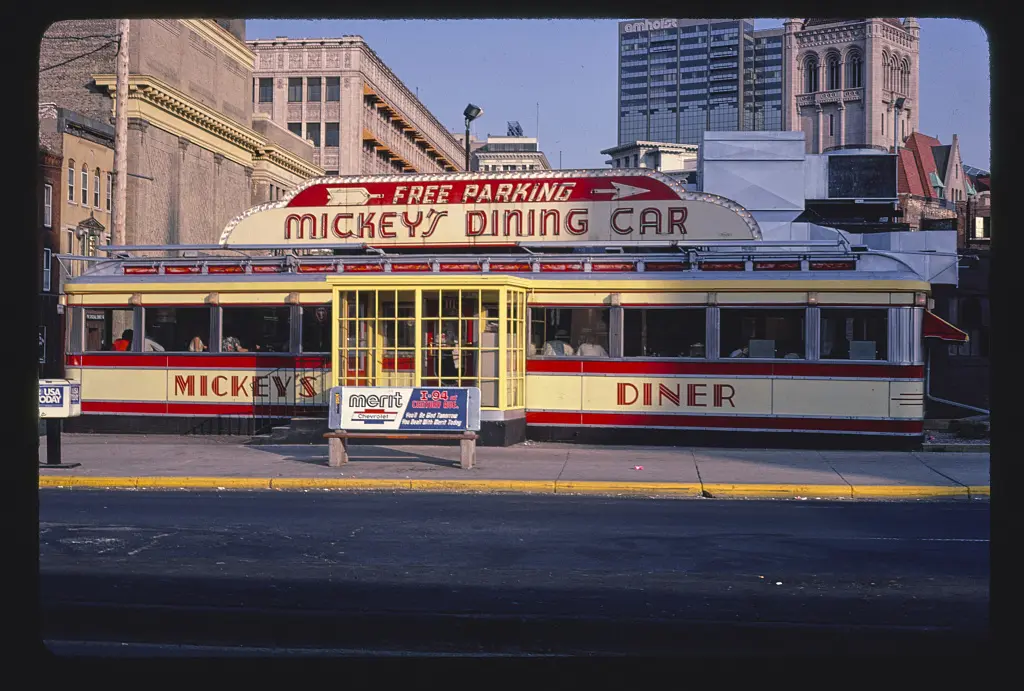
A dining car usually promises a meal while the landscape moves. Mickey's Diner offers the image of that experience while remaining in Saint Paul. John Margolies's photograph is cataloged under the diner's name and a 1937–39 construction range.[1]
Minnesota Historical Society's MNopedia account explains the building's actual journey. The Jerry O'Mahony Diner Company prefabricated it in Elizabeth, New Jersey, in 1937, and it was shipped to Saint Paul by rail. The narrative dates its opening under Mickey Crimmons and Bert Mattson to 1939. It describes a fifty-by-ten-foot structure with porcelain-enameled steel panels and train-style windows.[2] The railway resemblance was therefore more than a superficial association: rail transport also helped deliver the restaurant to its site.
Prefabrication rearranges the familiar story of architecture. Much of the building's making happens far from the corner where it becomes known. Its eventual local identity is created by use rather than by the geographic origin of every component. A manufactured diner can become deeply attached to a neighborhood because people repeatedly choose it, work in it, and organize memories around it.
The same historical account records National Register listing on February 24, 1983.[2] Such recognition asks the public to see design significance in a compact commercial building. A place associated with routine meals becomes something that merits deliberate documentation. The change is in attention as much as in the object itself: qualities that customers experienced informally are translated into an argument for historical value.
The rail-car reference makes the diner especially interesting to read at rest. Repeated windows and a narrow body suggest a passenger compartment, while the counter establishes a more concentrated social arrangement. It was purpose-built as a diner, rather than converted from a railroad car.[2]