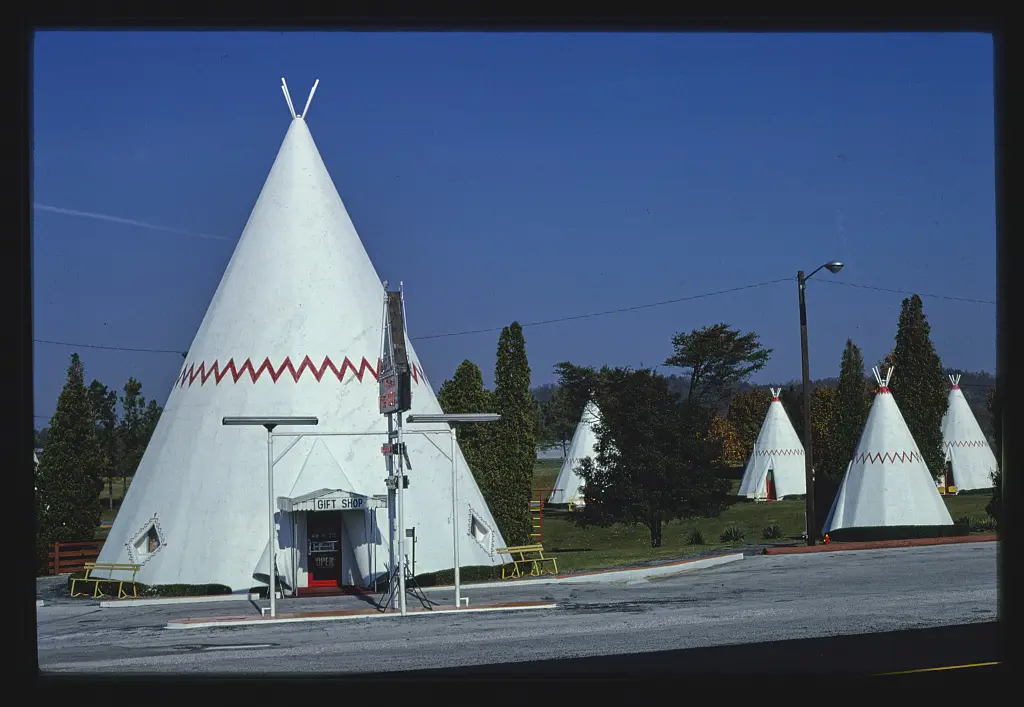
John Margolies's 1979 photograph identifies both the office and several cabins at Wigwam Village No. 2 on Kentucky's Route 31W.[1] The title already describes the essential business arrangement: an office serving a group of separate sleeping units. What made the motor court memorable was the decision to give those familiar functions pointed, conical shells.
The National Register nomination dates the Cave City complex to 1937 and describes eighteen steel-and-concrete tepees. It places the property between old and new alignments of Highway 31W and near the road leading toward Mammoth Cave. The nomination treats the buildings as roadside vernacular architecture rather than as examples of Indigenous construction.[2] That distinction is central to understanding the place.
A National Park Service teaching history traces the concept to Frank Redford, who established an earlier Kentucky village in 1933 and obtained a design patent in 1937. The Cave City village included fifteen sleeping units and a much larger central building. Eventually the commercial idea spread to seven villages.[3] The pointed shape was therefore both a tourist fantasy and a repeatable business design, capable of traveling well beyond its first setting.
The name needs to be read critically. “Wigwam” and “tepee” were deployed as marketable shorthand, collapsing different Indigenous dwelling traditions into one roadside image. This motel is evidence of how a commercial enterprise packaged an imagined Native American experience for travelers. Its survival does not make that representation accurate. A useful encounter with the architecture can acknowledge its visual ingenuity while asking whose culture supplied the sales pitch and who controlled its use.
The relationship between repetition and difference is equally interesting. Separate cabins ordinarily promise a measure of privacy. Here their repeated outlines also create a single recognizable group. An individual room participates in the larger sign of the village; an arriving guest is sold both a bed and a temporary place within the composition. The central building makes the same form do another job, distinguishing a shared destination by changing its scale.