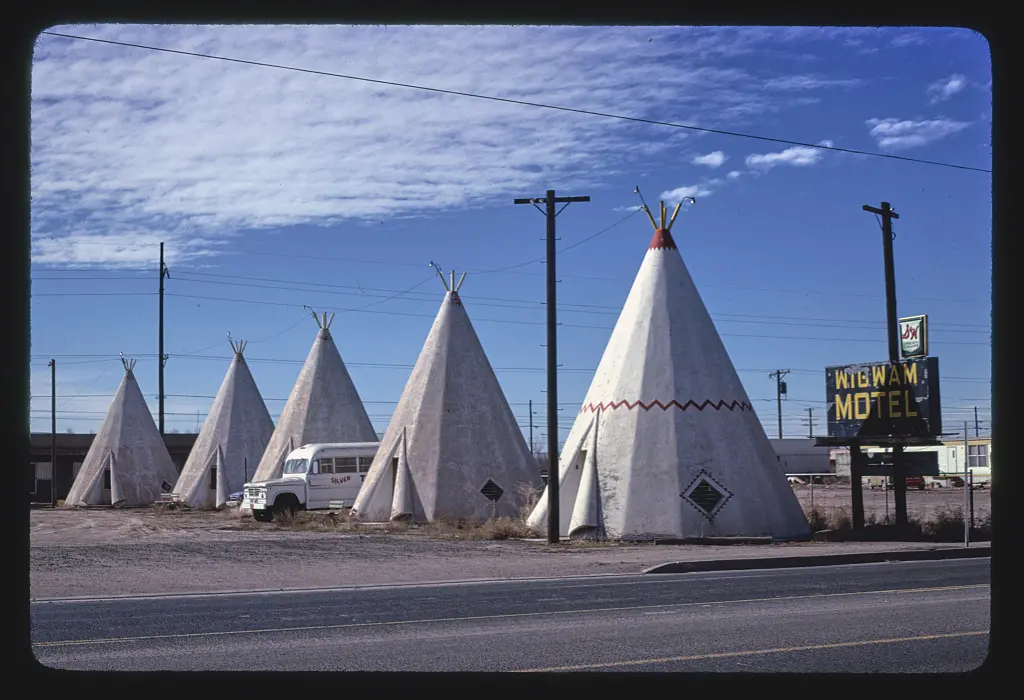
Fifteen freestanding rooms repeat the same pointed silhouette around a semicircle. Holbrook's Wigwam Village made the room itself into the roadside attraction, offering a recognizable shape instead of an anonymous corridor.[2]
Chester Lewis encountered Frank Redford's Wigwam Village in Cave City, Kentucky, in 1938. He bought the plans and the right to use the name. Their agreement included coin-operated radios: the receipts would become royalty payments. Lewis completed the Holbrook village in 1950, using steel and concrete for its separate units.[2]
The name conceals a cultural distinction. The forms resemble tipis, not wigwams; Redford preferred 'wigwam' as a business name, according to the National Park Service.[2] Different Indigenous building traditions were compressed into a generalized commercial image. The architecture's ingenuity and that simplification belong to the same history.
The motel also complicates the idea of roadside individuality. Each room repeats a design, and the village reproduces a concept licensed from another state. A distinctive outline could be a repeatable commercial product long before it became a celebrated local landmark.
Margolies photographed Village No. 6 in 1979.[1] Lewis's family repurchased the property and reopened the motel in 1988; National Register listing followed in 2002.[2] His image precedes those later chapters.
The layout gives an overnight stay the form of a temporary small dwelling. Room, car, and open space remain closely related. That spatial intimacy helps explain the village's appeal, while the licensed design and inaccurate name expose the mechanisms behind its apparent uniqueness: a marketable form, repeated rooms, and a version of the West made portable.